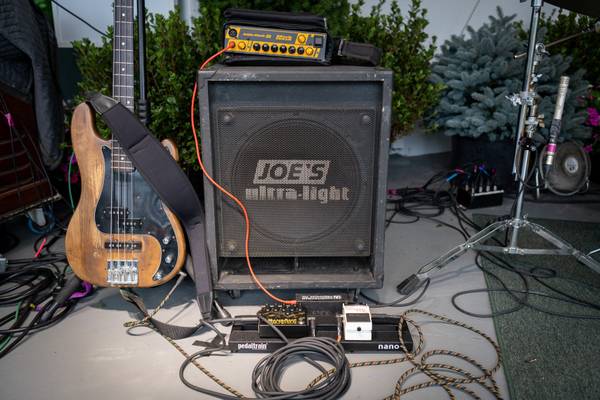
JOE'S ultra-light 15” ported bass cabinet for sale.
Punchy, light and virtually indestructible.
Loaded with an Eminence Legend series CA154 15” 4 ohm speaker rated for 300 watts.
Built like a brick . . . tank! Watch the video.
Cabinet has casters, it rolls nicely. Not heavy as the article below states - ULTRA-LIGHT!
24”H x 19”d x 17.5”w. Approx. 50lbs.
Not particularly pretty. Could use a paint job!
Speaker is under 5 years old and the cabinet dates from the late seventies with mojo aplenty.
When you know, you know!
IF YOU ARE INTERESTED YOU WILL NEED TO BRING AN AMP HEAD TO TRY IT OUT.
$400 cash and pickup only - Salisbury Beach.
Watch the video - https://www.youtube.com/watch?v=rUOeTIQemn4&t=5s
Some history (c/o TalkBass)
"Joe's Sound and Salami started in a row house that was once a funeral parlor located on a corner of Broad Street in Trenton, NJ, by three guys named Robin Gately, John Fish and "Dewey" Williamson. At least two of them or all three went to Ithaca College. Their idea was to build a local/regional live sound reinforcement company that specialized in extremely efficient PA systems that could fit into a 1 ton van - modular sound systems. So, these cabinets were not designed for bass or guitar amplification, but as PA components even though some local musicians did use them in their rigs (I still have a 2x12 cab for my guitar rig and my brother owned a pair of 1x18 cabs for his bass rig until he decided they were too much to deal with).
I believe the bulk of the speaker cabinet design was done by John Fish. They used to do some wild stuff to come up with SPL measurements. The ideal way to do that is to measure the cabinet in space but, being located in the capital city of New Jersey and the cabinets weighing a lot and not being able to launch them into space, they would point them out the window (a half space) with a microphone extended out in front and blast white noise out to the street below.
Originally, the cabinets were all painted white to make them distinctive but potential customers were reluctant to use a white PA system as they felt it detracted from the stage so they started painting them black (you can tell if you have one of the really old cabinets if you discover a layer of white paint under the black). Later, the name of the company was changed from Joe's to Modular, presumably because it sounded more professional.
The company definitely had a DIY spirit. They designed and fabricated all of the original cabinets themselves in a rented garage located up the street that they converted into a wood shop. They even silk screened their own t-shirts with the company logo.
Cabinet construction
Those cabinets were built like rocks; no resonance and you could beat on them with a hammer and, as someone noted, are HEAVY. You think a single 15 is heavy? Try lugging a double 18 up a flight of narrow stairs to the third floor of some dingy club named "Ray's." They were build from a layer of 3/4" Baltic birch plywood and a layer of 1/4" American ply. The inside of the cabinet then had a layer of fiberglass resin applied to it along with fiberglass cloth; the outside a layer of just the resin. The resin made the cabinets very stiff and added a layer of protection to the wood. The inside was filled with fiberglass insulation. The outside was then painted with exterior latex paint bought from a paint store down the street and applied with rollers and foam brushes to get the tight spots (when the cabinets started to look shabby, we'd repaint them).
Most of the cabinets were loaded with JBL drivers although EVs were used sometimes as well.
Cabinet configurations:
1x18
2x18
1x15
2x15
1x12
2x12
2x12 + 1x high frequency driver (some sort of JBL with a detachable lens) - mid/high cab
2x12 + 2x high frequency driver (some sort of JBL with a detachable lens) - mid/high cab
1x12 + 1x high frequency driver (some sort of JBL with a detachable lens) - stage monitors; known as "Stage Eliminators"
Slide Align
The coolest part of the mid/high boxes and the stage monitors was a component they called "Slide Align." I'm not going to pretend to be able to recall the whole concept, but the idea was to keep phasing to a minimum between the high freq. driver and the mid and low (mid/high cabs would be stacked on low cabs) and these were measured out so that the mid driver sat back away from the plane of the bass cab a certain amount; then, the high freq. drivers were situated on rails inside the mid/high box that would slide out a certain amount to put everything in alignment. The genius part is that the cab, with the high freq. driver out was not modular, but when you slid it back in it was. What I can tell you with absolute certainty is that you could definitely hear a difference when the PA was aligned and when it wasn't. Whatever they were doing, it worked.
End of the cabinets
Eventually, John Fish left the company as did Robin Gately leaving Dewey Williamson as the only remaining founder of the company and he moved the operation across the Delaware River into Morrisville, Pennsylvania. Over the course of time, he (or the company as a whole) decided that the cabinets weren't serving their purpose and moved on to another design (I don't know the actual reason behind it; perhaps construction and maintenance costs or moving on to larger rooms where flying was needed are possibilities).
I had a great time working for them; I was there for about a year during my senior year of high school and worked at lots of great shows (Ray Charles, Black Flag, Arlo Guthrie and so on and so on) and learned a great deal from them. Sadly, some of the guys from there have passed on - Robin Gately in a jet ski accident and Foster Waddel from a heart attack.
Joe's S&S had a cool video at Namm......https://www.youtube.com/watch?v=rUOeTIQemn4&t=5s
They chained a cab behind a pickup, and drove though a bunch of alleys, with the thing bouncing off dumpsters and everything else. The cab held together perfectly.
If that's the video I'm thinking of, it was titled "The Keystoned Roadies." We didn't use a chain, it was an actual cable with an XLR connector - for realism. Yeah, we abused the crap out of those cabinets including tossing one off of the roof of the third story building where the company was located, four guys chucking a cab in the back of the truck (with enthusiasm) and backing the truck up to the cab against a building wall and nailing the accelerator to get the tires smoking. I was in the video as one of the roadies - I was the guy standing on the cab to adjust a light trestle, rocked the cab like I was unbalanced then kicked it out from under me and off of the stage at City Gardens." - posted on TalkBass.